


2025 Volume 8 Issues 1–3
|
|
INEOS OPEN, 2025, 8 (1–3), 164–165 Journal of Nesmeyanov Institute of Organoelement Compounds Download PDF |
|


Preparation of Three-Dimensional Porous Amino-Substituted Cyclophosphazenes
E. A. Karpova, A. A. Sysoev, I. M. Rozhkov, and M. A. Soldatov*
Mendeleev University of Chemical Technology, Miusskaya pl. 9, Moscow, 125047 Russia
Corresponding author: M. A. Soldatov, e-mail: soldat89.89@gmail.com
Received 23 January 2025; accepted 24 March 2025
Abstract

A number of highly cross-linked porous polymers have been synthesized by the polycondensation of hexachlorocyclotriphosphazene and piperazine. It was found that the nature of solvents, used for the synthesis and purification of the resulting porous polymer, may significantly affect the porosity of the polymer. Thus, the use of polar tetrahydrofuran leads to an increase in the porosity owing to a higher conversion of reactive groups and higher cross-linking degree. The use of methanol for the purification of polymers by the extraction method leads to a decrease in the porosity due to the replacement of piperazine units.
Key words: cyclophosphazenes, piperazine, porous polymers, cross-linking.
Introduction
Phosphazene compounds represent a promising class of modern polymeric materials. It includes a wide range of inorganic and organometallic molecules with various chemical structures. The distinctive feature of phosphazenes is the alternation in their structures of nitrogen and phosphorus atoms linked by two lateral substituents. A large number of phosphazene-based compounds with a wide range of chemical and physical properties have been obtained [1–3]. In particular, the cross-linked materials based on cyclic phosphazenes exhibited high potential for drug delivery systems, bulking coatings, highly sensitive fluorescent markers, biomaterials, highly efficient sorbents, metal extractants, catalysts, and so on [4].
Several methods have been proposed for the synthesis of piperazine-substituted cyclic phosphazenes with cross-linked structures [5, 6]. The resulting materials have been studied for use as the components of intumescent polypropylene materials [6] and for the development of drug delivery systems with the sustained and controlled release of doxorubicin [5]. However, the proposed synthetic methods are highly variable and poorly standardized, whereas the products and their properties are not fully studied, in particular, the porosity data were not given for these articles.
The goals of this work were to obtain porous piperazine-containing cross-linked materials based on a cyclic phosphazene and to study the effect of the solvent nature, used for the synthesis and purification, on the porosity of the resulting polymers. The materials obtained can be promising as catalysts or containers for various active compounds for their subsequent prolonged release.
Results and discussion
The formation of a porous structure requires non-flexible, rigid building blocks, such as cyclic moieties, which prevent pore collapse. The preparation of the amino-substituted phosphazene was carried out at a hexachlorocyclo-triphosphazene/piperazine molar ratio of 1:3 to achieve the highest cross-linking degree and complete chlorine substitution. Triethylamine was used to trap released hydrogen chloride. 1,4-Dioxane and tetrahydrofuran (THF) were used to study the effect of the type of solvents during the synthesis. The above solvents were chosen owing to their high polarity and solubilizing ability towards the initial monomers. Chloroform and methanol were used to study the effect of purification by the Soxhlet extraction on the product properties. Moreover, these solvents can dissolve the side low-molecular-weight products and can be easily removed due to low boiling points.
A noticeable difference was observed at the synthesis stage: a swollen white gel was obtained in THF, whereas in the dioxane medium the product was a brown powder. The FTIR spectra of the porous polymers obtained (Fig. 1) confirmed the presence of the P=N bonds of a phosphazene ring (1200 cm–1) in their chemical structures. All the spectra also exhibited the absorption bands in the region of 933 cm–1 and 956 cm–1, which correspond to the P–N bond stretches. A large number of bands typical for the piperazine bonds were present in the spectra of all polymers. It is noteworthy that the spectra of the products obtained in the dioxane medium showed the signals of residual P–Cl bonds (597 cm–1 and 510 cm–1).
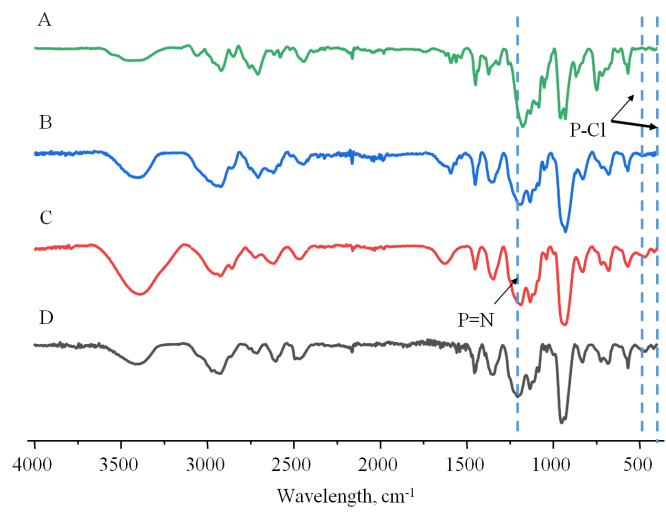
Figure 1. FTIR spectra of the resulting highly cross-linked polymers: synthesis in THF, purification with chloroform (A); synthesis in THF,
purification with methanol (B); synthesis in dioxane, purification with chloroform (C); synthesis in dioxane, purification with methanol (D).
The SEM and EDX analysis (see the Electronic supplementary information (ESI)) also revealed the increased content of chlorine atoms on the surface of the polymer samples obtained in the dioxane medium. This may indicate the incomplete nucleophilic substitution in the above solvent even at higher synthesis temperatures. This can probably be explained by a similarity of the structure of piperazine and dioxane, as well as a larger volume of the dioxane molecule compared to that of the THF molecule.
The study of the porosity parameters, such as the surface area (SBET) and average pore size (dpore), also showed that the properties of the products strongly depend on the synthesis and purification conditions (Table 1).
Table 1. Porosity data of the cross-linked polymers
|
Synthesis solvent
|
Extraction solvent
|
SBET, m2/g
|
dpore, nm
|
|
1,4-dioxane
|
Methanol
|
15.38
|
5.63
|
|
1,4-dioxane
|
Chloroform
|
11.05
|
3.06
|
|
THF
|
Methanol
|
9.08
|
3.84
|
|
THF
|
Chloroform
|
76.9
|
3.9
|
As can be seen, the use of methanol in the case of the polymer, synthesized in THF, leads to a decrease in the porosity. It is possible that hot methanol causes the non-equilibrium nucleophilic resubstitution of the piperazine molecules, disrupting the three-dimensional structure of the polymer and leading to a decrease in the porosity of the product.
Experimental section
All reagents were purchased from commercial sources, unless otherwise noted. 1,4-Dioxane and tetrahydrofuran were refluxed over sodium and distilled at atmospheric pressure under a dry argon atmosphere. Hexachlorocyclotriphosphazene and anhydrous piperazine were used without further purification. The FTIR spectra were obtained on a Jasco FT-IR-4600 spectrophotometer. The microstructure and elemental analysis of the surface were measured with a Tescan Vega 3 scanning electron microscope. The nitrogen sorption isotherm measurements were characterized with an Anton Paar Kaomi for Nova v1.0 surface area and pore-size analyzer. Before measurements, the samples were degassed at 150.0 °C with a rate of 5.0 deg/min then hold for 360 min.
Syntheses of the cross-linked polymers. In a three-necked flask equipped with a reflux condenser and a magnetic stirrer, anhydrous piperazine (1.485 g, 0.01725 mol) was added in 60 mL of the dry solvent. When the piperazine was completely dissolved, triethylamine (2.5 mL, 0.01725 mol) was added. Then a solution of hexachlorocyclotriphosphazene (2 g, 0.00575 mol) in 60 mL of the solvent was added dropwise at room temperature. The reaction mixture was heated to reflux and stirred for 72 h.
The resulting suspension was filtered off. The precipitate was washed with 25 mL of the solvent and purified by extraction in the Soxhlet apparatus for 15 cycles. The purified gel was then dried under reduced pressure at 60 °C for 6 h until the solvent was completely removed.
Conclusions
The FTIR, SEM and porosity data indicated a strong effect of both the solvent used during the synthesis and the solvent used to purify the final product. Thus, the chemical structure and porosity of the resulting amino-substituted cross-linked phosphazene materials can vary significantly, depending on the synthesis and purification conditions. It is better to use a highly polar solvent for the synthesis and an aprotic solvent for the extraction purification in order to achieve a higher cross-linking degree and avoid a resubstitution reaction, respectively. Further comprehensive study of the factors directly or indirectly affecting the properties of three-dimensional polyphosphazenes is required.
Electronic supplementary information
Electronic supplementary information (ESI) available online: the results of SEM and nitrogen sorption studies. For ESI, see DOI: 10.32931/io2565a.
References
- R. U. Khan, L. Wang, H. Yu. Zain-ul-Abdin, M. Akram, J. Wu, M. Haroon, R. S. Ullah, Zh. Deng, X. Xia, Russ. Chem. Rev., 2018, 87, 109–150. DOI: 10.1070/RCR4757
- H. R. Allcock, in: Polyphosphazenes in Biomedicine, Engineering, and Pioneering Synthesis, A. K. Andrianov, H. R. Allcock (Eds.), ACS Symp. Ser. 1298, 2018, ch. 1, pp. 3–26. DOI: 10.1021/bk-2018-1298.ch001
- J. E. Mark, H. R. Allcock, R. West, Inorganic Polymers, 2nd ed., Oxford Univ. Press, Oxford, 2005.
- M. Ahmad, T. Nawaz, I. Hussain, X. Chen, M. Imran, R. Hussain, M. A. Assiri, S. Ali, Z. Wu, ACS Omega, 2022, 7 28694–28707. DOI: 10.1021/acsomega.2c01573
- S. Mehmood, L. Wang, H. Yu, F. Haq, B.-u. Amin, Md A. Uddim, M. Haroon, D. Shen, Z. Ni, Int. J. Polym. Mater. Polym. Biomater., 2022, 71, 139–147. DOI: 10.1080/00914037.2020.1809407
- P. Wen, Q. Tai, Y. Hu, R. K. K. Yuen, Ind. Eng. Chem. Res., 2016, 55, 8018–8024. DOI: 10.1021/acs.iecr.6b01527