


2025 Volume 8 Issues 1–3
|
|
INEOS OPEN, 2025, 8 (1–3), 98–100 Journal of Nesmeyanov Institute of Organoelement Compounds Download PDF |
|


Influence of Aliphatic Substituents on the Properties
of 2,1,3-Benzothiadiazole-Based Luminophores
D. E. Stakanova, V. V. Popova, E. A. Svidchenko,
O. V. Borshchev,* and S. A. Ponomarenko
Enikolopov Institute of Synthetic Polymeric Materials, Russian Academy of Sciences, ul. Profsoyuznaya 70, Moscow, 117393 Russia
Corresponding author: O. V. Borshchev, e-mail: borshchev@ispm.ru
Received 2 November 2024; accepted 3 December 2024
Abstract
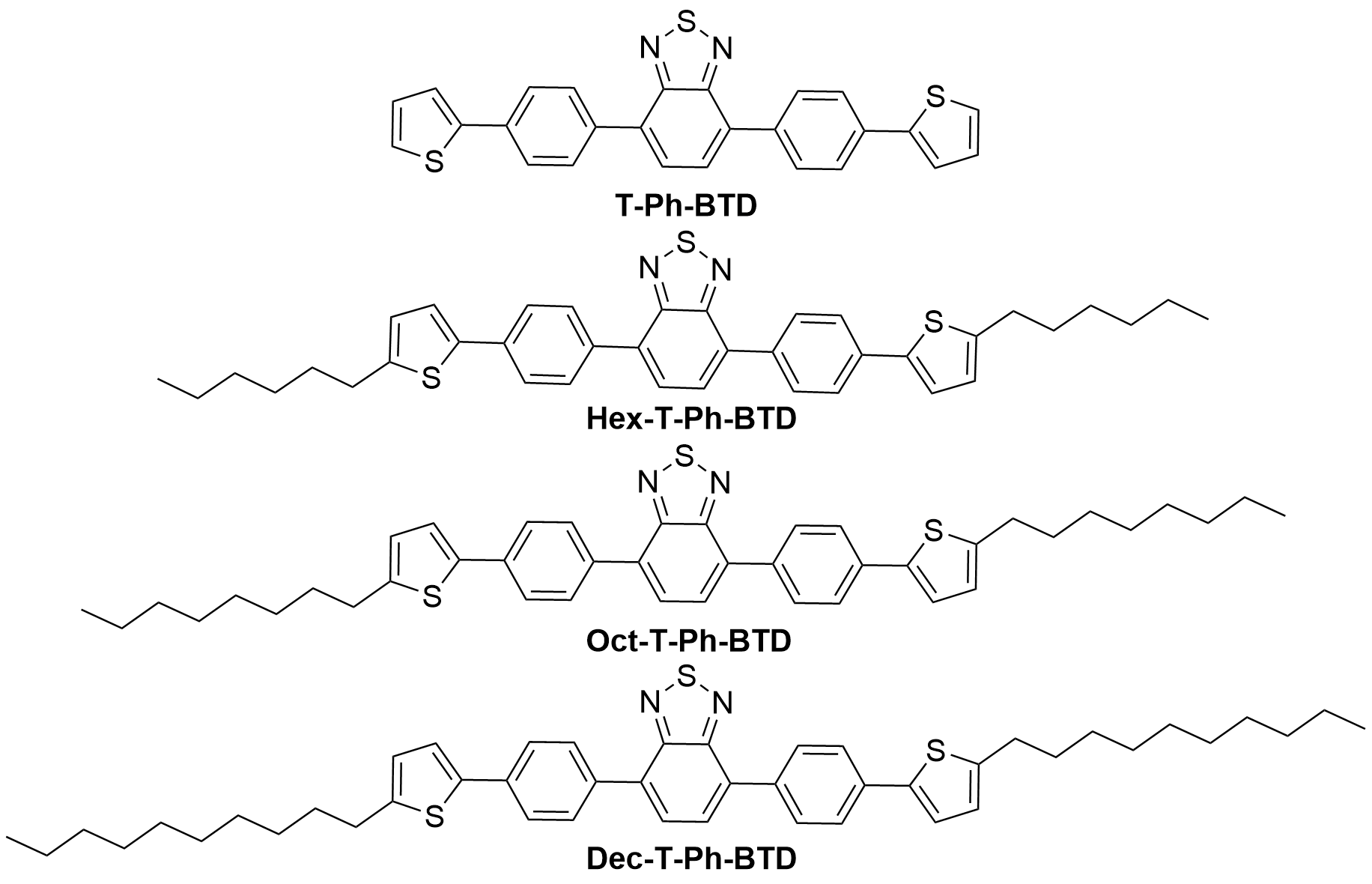
In this work, a series of 2,1,3-benzothiadiazole (BTD)-based organic luminophores which include 2,5-thiophene and 1,4-benzene moieties and terminal alkyl chains in their structures were synthesized. The effect of the length of the alkyl chain on the solubility, optical and thermal properties of the resulting luminophores was investigated. The introduction of alkyl substituents leads to a slight bathochromic shift of the absorption and luminescence maxima compared to their unsubstituted analog. As the length of the aliphatic chain increases, the melting point of the BTD-based luminophores decreases. The length of the aliphatic chain strongly affects the solubility of the molecules obtained.
Key words: 2,1,3-benzothiadiazole, synthesis, terminal substituents, luminescence.
Introduction
Currently, organic materials for electronics and photonics are among the fastest-growing areas of materials science [1]. Materials based on BTD have great potential for optoelectronic applications owing to their high molar extinction coefficients and excellent photostability [2, 3]. Such materials usually have a donor–acceptor–donor (D–π–A–π–D) structure, which allows easy tuning of their spectral properties [4]. Moreover, they exhibit very high structural variabilities, which can be changed by introducing terminal substituents such as trimethylsilyl, alkyl, or halogen [5–7]. The introduction of long aliphatic terminal groups can change the physicochemical characteristics of the compounds in both crystalline and solution forms [8]. However, this area has not been well studied. Therefore, it is important to investigate the properties of individual molecules to fully understand the effect of the length of the aliphatic substituent on the luminophore properties.
Results and discussion
Synthesis
Luminophores R-T-Ph-BTD, where R = H, hexyl, octyl or decyl, were synthesized by the Suzuki cross-coupling between 4,7-bis(4-bromophenyl)-2,1,3-benzothiadiazole (Br-P-BTD) and the corresponding organoboronic precursor (Scheme 1). To obtain Br-P-BTD, 4,7-diphenyl-2,1,3-benzothiadiazole was brominated in chloroform, using iodine as a catalyst (Scheme 2a) [9].
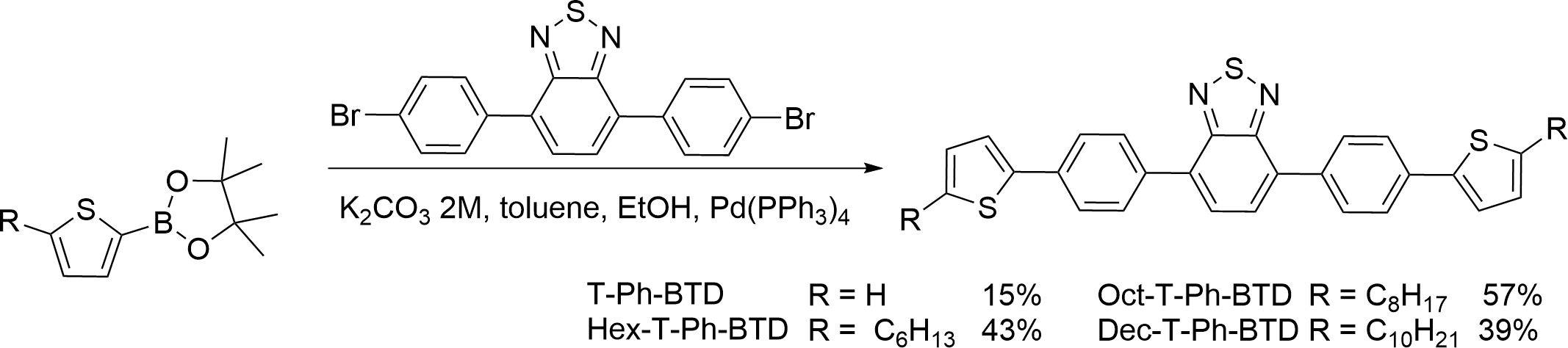
Scheme 1. Synthesis of R-T-Ph-BTD.
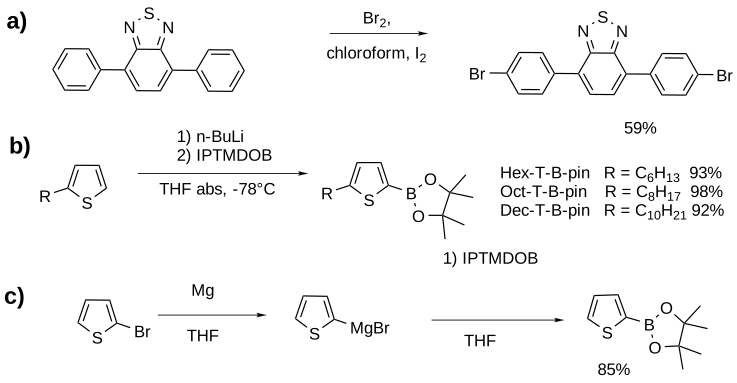
Scheme 2. Synthesis of the precursors.
The organoboronic precursors were synthesized in two different ways. For alkylthiophene derivatives, the corresponding alkylthiophenes were lithiated with n-buthyl lithium (nBuLi) and then reacted with 2-isopropoxy-4,4,5,5-tetramethyl-1,3,2-dioxaborolane (IPTMDOB), as shown in Scheme 2b. In the case of thiophene derivative T-B-pin, the Grignard reagent was prepared from 2-bromothiophene and reacted with IPTMDOB to give the target compound, as shown in Scheme 2c [10]. After the Suzuki reaction, the crude products were purified by recrystallization and column chromatography, which allowed us to obtain the target compounds with over 99% purity according to the results of GPC analysis.
Investigation of the solubility
The solubility of the resulting luminophores was investigated in THF as a solvent (Table 1). It was found that the presence of n-hexyl substituents slightly improves the solubility compared to that of unsubstituted compound T-Ph-BTD. However, the introduction of n-octyl and n-decyl substituents led to a decrease in the solubility.
Table 1. Solubility of the luminophores in THF
|
Luminophore
|
THF
|
|
|
S, g·L–1
|
SM, mM·L–1
|
|
|
T-Ph-BTD
|
2.01
|
4.43
|
|
Hex-T-Ph-BTD
|
2.75
|
1.72
|
|
Oct-T-Ph-BTD
|
1.49
|
2.20
|
|
Dec-T-Ph-BTD
|
1.26
|
4.45
|
Investigation of the optical properties
The results of the absorption and luminescence spectral measurements of the luminophores in diluted THF solutions are summarized in Table 2. It was found that the introduction of alkyl substituents leads to a slight bathochromic shift in the absorption and luminescence maxima compared to the spectra of their unsubstituted analog T-Ph-BTD. The absorption and luminescence spectra do not change significantly upon variation of the length of the alkyl chain. All the luminophores have a very high quantum yield Q, ranging from 86% to 90% with a standard deviation of 5%.
Table 2. Spectral properties of the resulting luminophores
|
Luminophore
|
abs λmax, nm
|
lum λmax, nm
|
ε, М–1⋅сm–1
|
Q, %
|
|
T-Ph-BTD
|
411
|
541
|
22840
|
86
|
|
Hex-T-Ph-BTD
|
421
|
555
|
26560
|
89
|
|
Oct-T-Ph-BTD
|
421
|
555
|
24020
|
90
|
|
Dec-T-Ph-BTD
|
420
|
554
|
24820
|
87
|
Investigation of the thermal properties
As shown in Table 3, the melting points of the luminophores with alkyl terminal groups are significantly lower (about 100 °C) than the melting point of their unsubstituted analog T-Ph-BTD. An increase in the length of the alkyl chain from hexyl to decyl leads to a decrease in the melting point from 156 °C to 133 °C. This indicates a significant reduction in the strength of intermolecular forces in the crystals.
Table 3. Thermal properties of the resulting luminophores
|
Luminophore
|
М, g/mol
|
Tm, °C
|
ΔHm, kJ/mol
|
T5%, °C
|
|
T-Ph-BTD
|
452
|
250
|
33.9
|
437
|
|
Hex-T-Ph-BTD
|
620
|
156
|
37.6
|
437
|
|
Oct-T-Ph-BTD
|
677
|
140
|
19.1
|
452
|
|
Dec-T-Ph-BTD
|
733
|
133
|
20.6
|
444
|
TGA analysis showed that the introduction of alkyl substituents into T-Ph-BTD has a very low influence on the thermal stability of the resulting luminophores in an inert atmosphere: all the luminophores were stable up to 437–452 °C. The highest thermal stability was observed for Oct-T-Ph-BTD.
Conclusions
Novel BTD-based luminophores with 2,5-thiophene and 1,4-benzene moieties and terminal alkyl substituents were synthesized. The spectral luminescent measurements revealed that the terminal substituents have a negligible effect on their optical properties in diluted THF solutions. When the alkyl substituents are introduced, there is observed a slight shift in the absorption and luminescence maxima by 13–14 and 9–10 nm, respectively. However, the length of the alkyl chain does not significantly affect the absorption or luminescence spectra as well as luminescence quantum yield, which ranged within 86–90%. The thermogravimetric analysis showed that all the luminophores obtained are stable in an inert atmosphere up to ca. 440 °C. Thus, the BTD-based luminophores exhibit high chemical and thermal stability, high quantum yields and represent versatile and suitable objects for various applications.
Acknowledgements
This work was supported by the Russian Science Foundation (project no. 22-13-00255).
Electronic supplementary information
Electronic supplementary information (ESI) available online: the experimental section, NMR spectra, optical and TGA data. For ESI, see DOI: 10.32931/io2536a.
References
- B. A. D. Neto, A. A. M. Lapis, E. N. Da Silva Júnior, J. Dupont, Eur. J. Org. Chem., 2013, 228–255. DOI: 10.1002/ejoc.201201161
- P. Anant, H. Mangold, N. T. Lucas, F. Laquai, J. Jacob, Polymer, 2011, 52, 4442–4450. DOI: 10.1016/j.polymer.2011.07.053
- A. Pazini, L. Maqueira, F. Da Silveira Santos, A. R. Jardim Barreto, R. dos Santos Carvalho, F. M. Valente, D. Back, R. Queiroz Aucélio, M. Cremona, F. Severo Rodembusch, J. Limberges, Dyes Pigm., 2020, 178, 1083771. DOI: 10.1016/j.dyepig.2020.108377
- R. Liu, C. Zhou, Q. Ding, L. Qu, K. Wang, H. Tang, Y. Li, C. Yang, Dyes Pigm., 2023, 219, 111588. DOI: 10.1016/j.dyepig.2023.111588
- V. A. Postnikov, G. A. Yurasik, A. A. Kulishov, M. S. Lyasnikova, O. V. Borshchev, E. A. Svidchenko, N. M. Surin, Crystallogr. Rep., 2021, 66, 1125–1132. DOI: 10.1134/S1063774521060262
- M. S. Skorotetcky, E. D. Krivtsova, O. V. Borshchev, N. M. Surin, E. A. Svidchenko, Y. V. Fedorov, S. A. Pisarev, S. A. Ponomaremko, Dyes Pigm., 2018, 155, 284–291. DOI: 10.1016/j.dyepig.2018.03.043
- R. S. Fedorenko, A. V. Kuevda, V. A. Trukhanov, A. Yu. Sosorev, A. V. Bakirov, A. I. Dorokhov, N. M. Surin, O. V. Borshchev, S. A. Ponomarenko, D. Yu. Paraschuk, Mater. Chem. Front., 2022, 6, 3279–3295. DOI: 10.1039/D2QM00768A
- C. B. Nielsen, A. J. P. White, I. McCulloch, J. Org. Chem., 2015, 80, 5045–5048. DOI: 10.1021/acs.joc.5b00430
- E. Shi, H. Zhuang, Z. Liu, X. Cheng, H. Hu, N. Li, D. Chen, Q. Xu, J. He, H. Li, J. Lu, J. Zheng, Dyes Pigm., 2015, 122, 66–73. DOI: 10.1016/j.dyepig.2015.06.017
- H. Kim, M. R. Reddy, H. Kim, D. Choi, C. Kim, S. Seo, ChemPlusChem, 2017, 82, 742–749. DOI: 10.1002/cplu.201700070