


2025 Volume 8 Issues 1–3
|
|
INEOS OPEN, 2025, 8 (1–3), 93–95 Journal of Nesmeyanov Institute of Organoelement Compounds Download PDF |
|


Ferrocene-Containing Mesoionic Oxadiazoles: Synthesis and Phytoactivity
N. V. Kalganova, E. V. Shevaldina, and I. A. Cherepanov*
Nesmeyanov Institute of Organoelement Compounds, Russian Academy of Sciences, ul. Vavilova 28, str. 1, Moscow, 119334 Russia
Corresponding author: I. A. Cherepanov, e-mail: cherepanov@ineos.ac.ru
Received 3 November 2024; accepted 10 January 2025
Abstract
Ferrocene-containing mesoionic oxadiazoles, namely, N‑substituted N-(sydnon-4-yl-methyl)ferrocenecarboxamides and N6-[2-methyl(ferrocenylmethyl)amino]acetylsydnone imines were synthesized and studied for growth-regulating and antidote activity towards the herbicide Zinger WP.
Key words: ferrocene, sydnone, sydnone imine, plant growth regulator.
Introduction
Ferrocene-containing heterocyclic compounds are of interest owing to their high potency for application in biology, medicine, and agriculture [1–8]. The presence of a ferrocenyl moiety generally increases the bioavailability of compounds, reduces the toxicity and increases the stability in biological media. At the same time, the commercial availability of ferrocene derivatives with functional groups provides the possibility of introducing a metallocene moiety into a wide variety of heterocycles and obtaining a significant number of diverse compounds for studying their biological properties.
Recently, it has been shown that ferrocene-containing mesoionic oxadiazoles (sydnones, sydnone imines) affect the growth and development of plants during pre-sowing seed treatment in ultra-low doses (10–5–10–3 mol per ton of seeds) and, depending on their structures, exhibit growth-stimulating, herbicidal or herbicide antidote activity [9–12]. In the studied compounds, the sydnone or sydnone imine heterocycle and the ferrocenyl substituent were connected by various spacers at different positions of the mesoionic moiety (Fig. 1).
Figure 1. Ferrocene-containing mesoionic oxadiazoles [9–12].
The earlier developed synthetic approaches to ferrocene-containing heterocycles provide access to a wide range of structures, but are not exhaustive. In this work, we demonstrate the synthesis of new types of ferrocene-containing mesoionic oxadiazoles—N-substituted N-(sydnon-4-yl-methyl)ferrocene-carboxamides and N6-[2-methyl(ferrocenyl-methyl)amino]acetylsydnone imines.
Results and discussion
Ferrocenoyl chloride is an inexpensive commercially available synthon of a ferrocene moiety, which can be used for the modification of various heterocycles. To synthesize ferrocenecarboxamides using this reagent, it is necessary to have a primary or secondary amino group in the molecule of the mesoionic heterocycle. The only known method for the synthesis of 4-aminomethyl derivatives of sydnones is the Mannich aminomethylation of 4-unsubstituted sydnones [13, 14]. We showed that 4-N-monosubstituted aminomethylsydnones 1 can be readily obtained by the reduction of 4-formylsydnone imines [15] with sodium borohydride (Scheme 1).
Scheme 1. Synthesis of sydnonylferrocenecarboxamides 2a–c.
Ferrocene-containing sydnones 2 were isolated in high yields by crystallization without the use of chromatographic separation methods. Compounds 2 are dark brown crystalline compounds, which are stable in air.
The introduction of a ferrocenyl moiety into a substituent at the exocyclic nitrogen atom of sydnone imines is a rather complex task. We used an approach [16, 17] based on the high mobility of the halogen atom at the alpha position of the N6-acetyl substituent in derivatives 3 (Scheme 2). A series of ferrocene-containing N6-aminoacetyl sydnone imines 4 were synthesized in good yields by the reactions of 3 with N-methyl-N-(ferrocenylmethyl)amine.
Scheme 2. Synthesis of ferrocene-containing N6-aminoacetyl sydnone imines 4a–c.
Ferrocene-containing mesoionic oxadiazoles 2a–c and 4a–c were studied for the growth-regulating and antidote activities against the sulfonylurea herbicide in vegetation experiments on corn seedlings.
To test the biological activity of derivatives 2a–c and 4a–c, aqueous solutions of these compounds were required. Some experimental difficulties arose in preparing these solutions. The ferrocene derivatives of mesoionic compounds are highly lipophilic and practically do not dissolve in water. The problem was solved as follows. A sample of 1.375·10–5 mol of the compound was dissolved in 10 mL of ethanol; the successive 10- and 50-fold dilution with water afforded stable solutions of the compounds under consideration.
The studies were conducted on corn seeds of the Krasnodar 291 AMV cultivar. 2.75·10–6 M aqueous solutions of compounds 2a–c and 4a–c were used at a dose of 2.5·10–3 mol·t–1 of seeds. To study the antidote activity, the herbicide Zinger WP (60% metsulfuron-methyl, CAS 74223-64-6) was used as a representative of the sulfonylurea herbicides. This herbicide is characterized by the increased stability in soil and is widely used in agriculture. 1.7·10–7 M aqueous solution of the herbicide at a dose of 2.6·10–4 mol·t–1 of seeds was used either separately (the herbicide control) or together with test compounds 2a–c, 4a–c at a dose of 2.5·10–3 mol·t–1 of seeds.
The seeds were germinated under thermostatic conditions at a temperature of 25 ℃ for 96 h, after which the sum mass of roots and sprouts was measured separately in each experiment. The results were compared with the data of the water and herbicide control experiments, in which the corn seeds were germinated using distilled water or the herbicide solution. The average sum mass of sprouts and roots of the water control was taken as 100%. The experimental procedure, the results, the statistical processing and the method for calculating the antidote activity are given in the Electronic supplementary information (ESI).
The antidote activity of the tested compounds was assessed by comparing the values of Eexp and Ecalc. Eexp is the experimental growth-regulating effect of a combination of the tested compound and metsulfuron-methyl. Ecalc is the expected value calculated according to formula (1) [18].
|
|
Ecalc = (x ´ y) : 100,
|
(1)
|
where Ecalc is the expected growth regulation value on the combined action of the tested compound and the herbicide expressed as a percentage of the reference value, x is the experimental growth regulation value in the presence of the tested compound expressed as a percentage of the reference value, and y is the experimental growth regulation value in the presence of the herbicide expressed as a percentage of the reference value. Equation (1) suggests that the two active substances affect the plant growth independently. A significant difference between the experimental and calculated values indicates the effect of one compound on the activity of the other.
Figure 2 summarizes the experimental (Eexp) and calculated (Ecalc) values of the growth-regulating effect for the combinations of the studied sydnones and the herbicide Zinger WP, as well as the difference [Eexp–Ecalc]. The large values of the difference indicate antagonism or synergism between the compound and the herbicide, with the positive difference meaning that the compound under study is an antagonist of the herbicide.
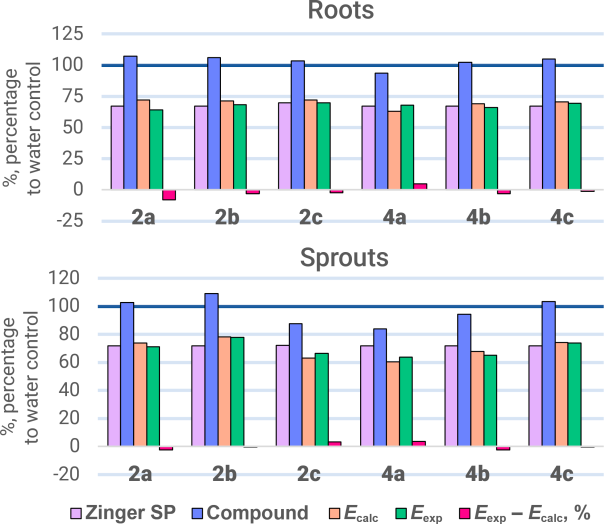
Figure 2. Growth-regulating and antidote activity of sydnones 2a–c and sydnone imines 4a–c at a dose of 2.5·10–3 mol·t–1 of seeds, the herbicide Zinger WP at a dose of 2.6·10–4 mol·t–1 of seeds, and their combined effect on the growth of corn seeds of the Krasnodar 291 AMV cultivar.
In general, the studied compounds were low-active and did not show statistically significant activity in the experiments conducted, except for compounds 2c, 4a, which demonstrated herbicidal effect on the development of corn sprouts at a dosage of 2.5·10–3 mol·t–1 of seeds.
Conclusions
It was demonstrated that the previously known methods for the functionalization of sydnones and sydnone imines can be successfully applied to obtain new types of ferrocene-containing mesoionic oxadiazoles. The first representatives of N-substituted N-(sydnon-4-yl-methyl)ferrocenecarboxamides and N6-[2-methyl(ferrocenyl-methyl)amino]acetylsydnone imines were synthesized. In vegetation experiments on corn seed sprouts, it was shown that some of these compounds affect the plant development, exhibiting herbicidal effects. The results obtained can be useful for specialists in the field of phytoactive compounds.
Acknowledgements
This work was supported by the Russian Science Foundation (project no. 22-23-00726, https://rscf.ru/project/22-23-00726/) and the Ministry of Science and Higher Education of the Russian Federation (agreement no 58.3). The NMR data were collected using the equipment of the Center for Collective Use of INEOS RAS.
Electronic supplementary information
Electronic supplementary information (ESI) available online: the experimental section, NMR spectra, and biological experiments. For ESI, see DOI: 10.32931/io2533a.
References
- M. F. R. Fouda, M. M. Abd-Elzaher, R. A. Abdelsamaia, A. A. Labib, Appl. Organomet. Chem., 2007, 21, 613–625. DOI: 10.1002/aoc.1202
- L. V. Snegur, A. A. Simenel, A. N. Rodionov, V. I. Boev, Russ. Chem. Bull., 2014, 63, 26–36. DOI: 10.1007/s11172-014-0390-4
- B. Floris, Chem. Biol. Technol. Agric., 2015, 2, 15. DOI: 10.1186/s40538-015-0038-0
- M. Patra, G. Gasser, Nat. Rev. Chem., 2017, 1, 0066. DOI: 10.1038/s41570-017-0066
- E. V. Shevaldina, K. A. Opredelennova, O. A. Chichvarina, Yu. Ya. Spiridonov, A. F. Smol'yakov, P. V. Dorovatovskii, S. K. Moiseev, Appl. Organomet. Chem., 2019, 33, e5228. DOI: 10.1002/aoc.5228
- H. Shoukat, A. A. Altaf, A. Badshah, in: Advances in Metallodrugs: Preparation and Applications in Medicinal Chemistry, Shahid-ul-Islam, A. A. Hashmi, S. A. Khan (Eds.), Wiley, Hoboken, 2020, ch. 4, pp. 115–136. DOI: 10.1002/9781119640868.ch4
- B. Sharma, V. Kumar, J. Med. Chem., 2021, 64, 16865–16921. DOI: 10.1021/acs.jmedchem.1c00390
- L. V. Snegur, Inorganics, 2022, 10, 226. DOI: 10.3390/inorganics10120226
- E. V. Shevaldina, V. A. Tsyganov, N. V. Kalganova, A. F. Smol'yakov, N. G. Frolova, I. A. Cherepanov, Appl. Organomet. Chem., 2022, 37, e6981. DOI: 10.1002/aoc.6981
- N. V. Kalganova, A. F. Smolyakov, S. K. Moiseev, M. A. Cherevatskaya, I. A. Cherepanov, Russ. Chem. Bull., 2023, 72, 1688–1700. DOI: 10.1007/s11172-023-3949-0
- N. V. Kalganova, N. G. Frolova, I. A. Godovikov, A. F. Smol'yakov, D. A. Lapshin, I. A. Cherepanov, J. Organomet. Chem., 2024, 1005, 122975. DOI: 10.1016/j.jorganchem.2023.122975
- N. V. Kalganova, N. G. Frolova, I. A. Godovikov, A. F. Smol'yakov, E. G. Kononova, I. A. Cherepanov, Appl. Organomet. Chem., 2024, 38, e7471. DOI: 10.1002/aoc.7471
- Z. Zhangbin, Y. Chenglie, W. Yongren, Chin. J. Org. Chem., 2002, 22, 283–285.
- P. P. Savaliya, V. K. Akbari, J. A. Modi, K. C. Patel, Med. Chem. Res., 2013, 22, 5789–5797. DOI: 10.1007/s00044-013-0568-6
- E. Bauschke, G. Tomaschewski, J. Prakt. Chem., 1978, 320, 206–216. DOI: 10.1002/prac.19783200205
- A. S. Samarskaya, I. A. Cherepanov, I. A. Godovikov, V. N. Kalinin, Dokl. Chem., 2015, 463, 199–203. DOI: 10.1134/S0012500815080017
- I. A. Cherepanov, A. S. Samarskaya, R. G. Nosov, I. A. Godovikov, Yu. V. Nelyubina, V. N. Kalinin, Mendeleev Commun., 2014, 24, 386–387. DOI: 10.1016/j.mencom.2014.11.027
- S. R. Colby, Weeds, 1967, 15, 20–22. DOI: 10.2307/4041058