


2025 Volume 8 Issues 1–3
|
|
INEOS OPEN, 2025, 8 (1–3), 84–86 Journal of Nesmeyanov Institute of Organoelement Compounds |
|


Study of Aminolysis of Cyclocarbonates by Alkoxysilanes
A. Yu. Kazantseva,*a,b E. S. Trankina,b E. S. Afanasyev,b and A. M. Muzafarovb,c
a Moscow Institute of Physics and Technology (National Research University), Institutskiy per. 9, Dolgoprudny, Moscow Oblast, 141700 Russia
b Nesmeyanov Institute of Organoelement Compounds, Russian Academy of Sciences, ul. Vavilova 28, str. 1, Moscow, 119334 Russia
c Enikolopov Institute of Synthetic Polymeric Materials, Russian Academy of Sciences, ul. Profsoyuznaya 70, Moscow, 117393 Russia
Corresponding author: A. Yu. Kazantseva, e-mail: kazantseva2132000@yandex.ru
Received 3 November 2024; accepted 1 December 2024
Abstract
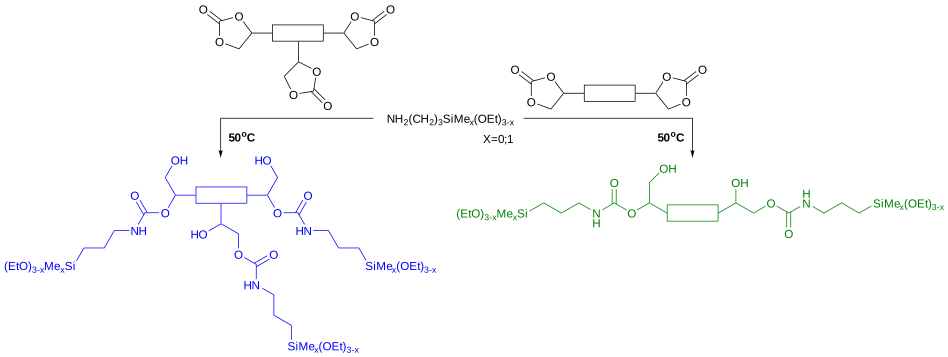
The kinetic regularities of the aminolysis of cyclocarbonates by alkoxysilanes bearing γ-aminopropyl substituents have been studied. New silyl-modified urethane oligomers were obtained that represent promising binding agents; their adhesive properties to various surfaces (glass, metal, wood) were studied. The cross-linked film materials based on them were obtained and their physical, mechanical, and thermal characteristics were studied.
Key words: non-isocyanate poly(siloxane–urethane)s, amino-functionalized alkoxysilanes, aminolysis of cyclocarbonates.
Introduction
Polyurethanes are among the most common and popular polymers. However, their industrial production is very toxic. Therefore, recently the investigations on the development of alternative methods for obtaining these materials have become popular. Among the chemical processes described in the literature that lead to the formation of a urethane group without the participation of isocyanates [1], the aminolysis of cyclocarbonates is considered the most promising one, since the reaction is not sensitive to moisture and the initial components do not have the same toxicity as isocyanates and phosgene.
Many works have been devoted to the investigations on this method [2–4], but the reports on the use of silicon-containing reagents in this process remains relatively scarce. Taking this into account, the goal of this work was to study the kinetic regularities of the aminolysis of organic cyclocarbonates by alkoxysilanes with γ-aminopropyl substituents and to explore the physicomechanical properties of the materials based on the resulting urethane–urea–siloxane oligomers.
Results and discussion
As the starting components, we selected cyclocarbonates of different structures (Fig. 1), namely, linear dicyclocarbonate (based on propylene oxide) L-CC, linear-branched tricyclocarbonate (based on trimethylolpropane and propylene oxide) LB-CC, branched tricyclocarbonate (based on trimethylolpropane) B-CC, aromatic dicyclocarbonate (based on bisphenol A) A-CC and amines (3-aminopropyl)triethoxysilane (APTES) and (3-aminopropyl)diethoxymethylsilane (APDEMS) (Fig. 2). The process was carried out without using solvents. The conversion of the cyclocarbonates was determined using IR spectroscopy (Fig. 3).
Figure 1. Starting cyclocarbonates: linear dicyclocarbonate L-CC, linear-branched tricyclocarbonate LB-CC,
aromatic dicyclocarbonate A-CC, and branched tricyclocarbonate B-CC.
Figure 2. Structures of the starting amines: (3-aminopropyl)triethoxysilane (APTES) and (3-aminopropyl)diethoxymethylsilane (APDEMS).

Figure 3. IR spectra (transmission) of the reaction mixture based on L-CC and APTES.
For correct comparison of the resulting data, the IR spectra were subjected to additional processing and normalization relative to an absorption band of C–H stretches. Based on the changes in the peak areas, the dependence of the cyclocarbonate conversion on the reaction time was plotted (Fig. 4). The analysis of the results showed that the aminolysis rate is affected by several factors: the structure of the reagents and their ratio, as well as the temperature and catalyst. However, considerable effects were exerted by the temperature and amine excess in the system, which ensure the complete conversion without addition of a catalyst, as was confirmed by the literature data on the reaction mechanism [5]. The number of alkoxy groups at the silicon atom in the amine structure did not have a significant effect on the reaction rate: both amino-functionalized alkoxysilanes displayed high reactivity. Based on these data, all the silyl-modified urethane oligomers were obtained at 50 °C and different carbonate:amine ratios.
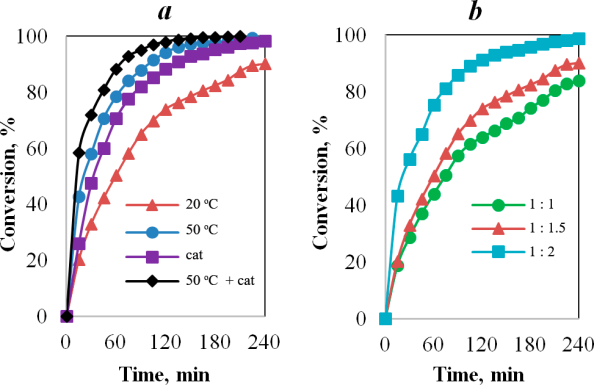
Figure 4. Dependence of the conversion of L-CC over time on the temperature and catalyst (a), molar ratio of the reagents (b).
The resulting silyl-modified urethane oligomers were tested as binding agents for metal, wood, and glass (Fig. 5). The bonding strength was determined by the shear loading method. The samples on aluminum substrates exhibited the values in the range of 0.5–2 MPa. The corresponding values for wood was 0.5–8 MPa; therewith, in the samples based on cyclocarbonates A-CC and B-CC, the wood was destroyed earlier than the adhesive layer. The bonding strength of glass was not measured, since the shear loading required to destroy the adhesive appeared to be higher than that required to destroy the glass substrate.
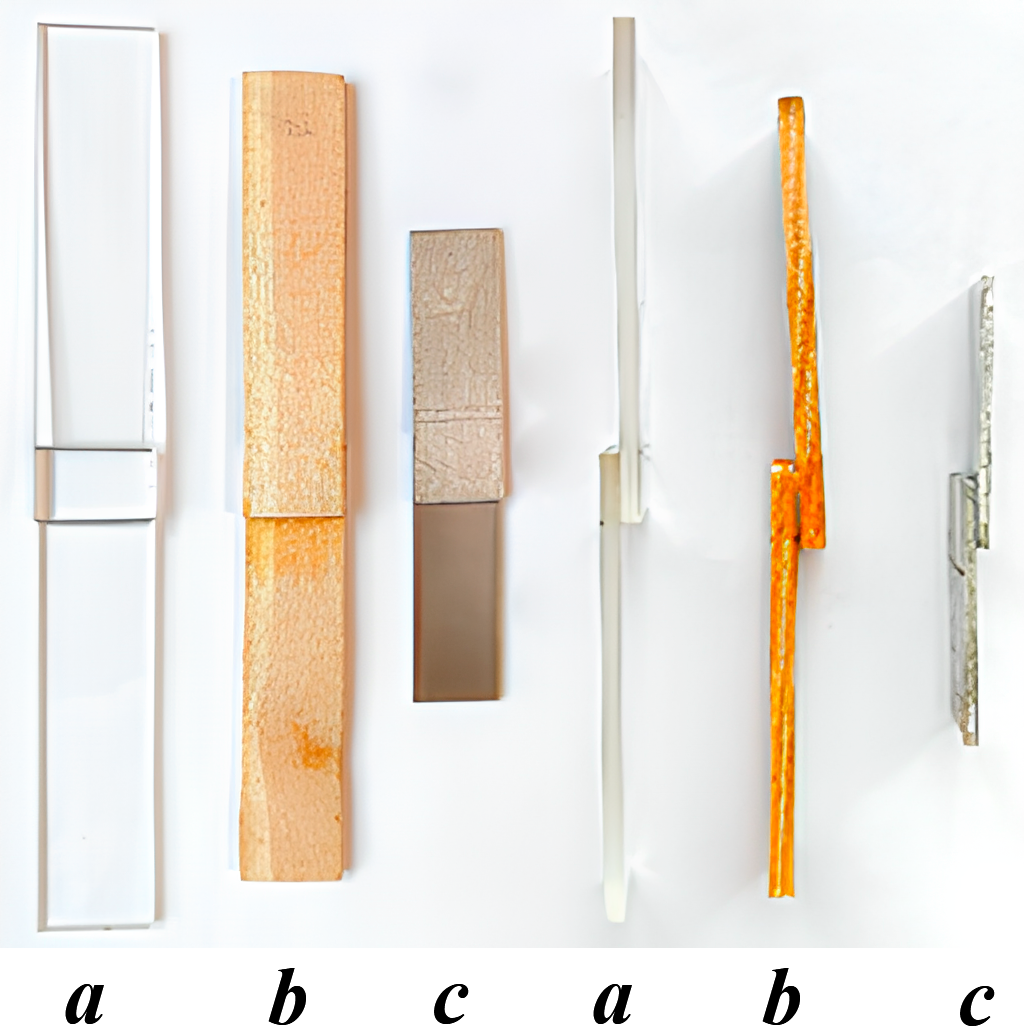
Figure 5. Photographs of the glued samples of glass (a), wood (b), and aluminum (c).
The resulting silylurethane prepolymers bearing reactive alkoxy groups at the silicon atom were used to obtain cross-linked film samples of non-isocyanate poly(siloxane–urethane–urea)s (NIPSUUs). The physical, mechanical (strength, relative elongation, elastic modulus), and thermal characteristics of the explored samples are presented in Table 1.
Table 1. NIPSUUs based on APTES and APDEMS and different cyclocarbonates
|
CC
|
СС:NH2 molar ratio
|
Gel fraction, %
|
ТМА
|
ТGА
|
Mechanical tests
|
||
|
Тg, ℃
|
Td5%, °C (air)
|
σ, МPa
|
ε, %
|
E, MPa
|
|||
|
APTES
|
|||||||
|
L-CC
|
1:1
|
98.7
|
–46
|
237
|
1.8
|
10.9
|
18
|
|
|
1:1.5
|
98.6
|
–30
|
233
|
3.1
|
10.3
|
32
|
|
LB-CC
|
1:1
|
85.5
|
–1.9
|
231
|
1.2
|
10.5
|
11
|
|
|
1:1.5
|
99.1
|
–2.4
|
230
|
8.4
|
10.1
|
101
|
|
B-CC
|
1:1
|
98.2
|
70
|
213
|
5.4
|
11.4
|
83
|
|
|
1:1.5
|
97.8
|
38
|
172
|
20.9
|
2.6
|
983
|
|
А-CC
|
1:1
|
96.1
|
78
|
152
|
26.2
|
1.6
|
1720
|
|
|
1:1.5
|
98.5
|
73
|
173
|
65.6
|
5.2
|
2750
|
|
APDEMS
|
|||||||
|
L-CC
|
1:1
|
89.2
|
–25
|
228
|
–
|
–
|
–
|
|
|
1:1.5
|
96.6
|
–20
|
223
|
1,9
|
37
|
6
|
|
LB-CC
|
1:1
|
89.1
|
–4
|
252
|
3.1
|
29.5
|
11
|
|
|
1:1.5
|
98.2
|
–6
|
220
|
2.4
|
32.1
|
7
|
|
B-CC
|
1:1
|
98.9
|
6
|
159
|
4.9
|
37
|
26
|
|
|
1:1.5
|
98.1
|
11
|
154
|
5.3
|
35.7
|
34
|
|
А-CC
|
1:1
|
92.3
|
42
|
230
|
21.8
|
36.3
|
830
|
|
|
1:1.5
|
99.1
|
67
|
135
|
52.5
|
5.2
|
2034
|
|
ТМА—thermomechanical analysis; TGA—thermogravimetric analysis; Tg—glass-transition temperature; Td5%—decomposition temperature corresponding to 5% mass loss; σ—tensile strength; ε—relative elongation; E—elastic modulus.
|
|||||||
The mechanical tests revealed a significant impact of the organic block structure on the tensile strength. On passing from the linear aliphatic structure of the organic block to the branched and aromatic structures, the value of σ increased from 1 to 65 MPa. The relative elongation was strongly influenced by the structure and amount of amine, or more precisely by the number of cross-links formed during curing; on passing from APTES to APDEMS, the values changed from 5 to 37%.
The A-CC-based samples clearly showed that an excess of the amine leads to the formation of a denser network, thus affording a significant increase in the tensile strength (from 21 to 53 MPa), a decrease in the relative elongation (from 36 to 5%), and, consequently, a significant increase in the elastic modulus (from 830 to 2034 MPa).
Conclusions
Hence, the aminolysis of cyclocarbonates of different structures and functionality by silanes containing both γ-aminopropyl and ethoxy substituents was studied. The reactive ethoxy groups remained intact and their subsequent hydrolysis can ensure the formation of a siloxane network in the polymer.
The silyl-modified urethane oligomers based on the silanes with γ-aminopropyl and ethoxy substituents at the silicon atom were obtained and used for the synthesis of cross-linked film materials, which were tested for their physical, mechanical, and thermal characteristics. The aromatic cyclocarbonate enabled the synthesis of the material with high strength characteristics and elastic modulus of 2750 MPa. The thermal decomposition processes in air began at temperatures above 150 °C.
Acknowledgements
This work was supported by the Ministry of Science and Higher Education of the Russian Federation (agreement no. 075-03-2023-642) using the equipment of the Center for Collective Use of INEOS RAS.
References
- O. Kreye, H. Mutlu, M. A. R Meier, Green Chem., 2013, 15, 1431–1455. DOI: 10.1039/c3gc40440d
- Mhd. Abd. C. Mhd. Haniffa, K. Munawar, Y. C. Ching, H. A. Illias, C. H. Chuah, Chem. Asian J., 2021, 16, 1281–1297. DOI: 10.1002/asia.202100226
- R. P. Tiger, M. V. Zabalov, M. A. Levina, Polym. Sci., Ser. C, 2021, 63, 113–125. DOI: 10.1134/S1811238221020090
- M. Rayung, N. A. Ghani, N. Hasanudin, RSC Adv., 2024, 14, 9273–9299. DOI: 10.1039/d3ra08684d
- M. S. Kathalewar, P. B. Joshi, A. S. Sabnis, V. C. Malshe, RSC Adv., 2013, 3, 4110–4129. DOI: 10.1039/C2RA21938G