


2025 Volume 8 Issues 1–3
|
|
INEOS OPEN, 2025, 8 (1–3), 28–29 Journal of Nesmeyanov Institute of Organoelement Compounds Download PDF |
|


Influence of Ddivalent Metal Promoters on the Pt Dispersion and Performance
of the Pt/MFI Propane Dehydrogenation Catalysts
A. B. Ponomaryov,*a A. V. Smirnov,b M. V. Shostakovsky,a
M. A. Kashkina,a,b and E. V. Pisarenkoс
a Nesmeyanov Institute of Organoelement Compounds, Russian Academy of Sciences, ul. Vavilova 28, str. 1, Moscow, 119334 Russia
b Department of Chemistry, Lomonosov Moscow State University, Leninskie Gory 1, str. 3, Moscow, 119991 Russia
с Department of Cybernetics of Chemical Technological Processes, Mendeleev University of Chemical Technology of Russia, Miusskaya pl. 9, Moscow, 125047 Russia
Corresponding author: A. B. Ponomaryov, e-mail: kalinkin@ineos.ac.ru
Received 14 October 2024; accepted 19 November 2024
Abstract
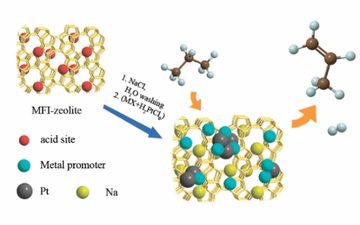
Divalent metal promoted Pt-based MFI-zeolite propane dehydrogenation (PDH) catalysts were prepared by the neutralization of zeolite acid sites with Na+ cations followed by the co-impregnation of the support with H2PtCl6 and the promoter salt. In general, the activity and stability of the catalysts increased in the presence of the promoter. The Pt dispersion demonstrated divergent trends indicating different strength of the interaction between Pt and the promoter metal. The best promoters in terms of productivity were ranked as follows: Zn >> Cu > Sn @ Mn.
Key words: propane dehydrogenation, zeolite, platinum, promoter, impregnation–calcination–washing method.
Introduction
Propylene is used as a feedstock for polymers and as an intermediate product for various chemicals. The production of propylene through PDH reaches millions of tons annually and is steadily increasing. Pt particles distributed on the surface of supports such as silica, alumina, and zeolites are the most active catalysts for the PDH reaction [1]. The platinum-catalyzed deep dehydrogenation and hydrogenolysis, as well as the acid-site-catalyzed cracking, oligomerization, and aromatization result in the formation of by-products. Even though the zeolite acid sites prevent platinum agglomeration, it is crucial to neutralize these sites to achieve an acceptable level of propylene selectivity. The primary challenge with Pt-based PDH catalysts is their rapid deactivation due to coking and agglomeration of platinum under harsh reaction conditions [2]. The performance of Pt catalysts is significantly enhanced by the addition of a promoter [3]. Promoters can improve Pt dispersion, increase the catalyst stability, and modify the Pt chemical state that affects the selectivity [4]. Many metals have been tested as platinum promoters for propane dehydrogenation. However, these studies have been conducted using different catalyst preparation methods (metal introduction methods, calcination temperatures, pretreatment conditions) and different test conditions. In this work, a number of divalent metals were added to platinum to compare their effect as Pt promoters.
Results and discussion
The catalysts were prepared and tested under identical conditions, and MFI zeolite with the SiO2/Al2O3 molar ratio of 80 was used as a support. The promoted Pt/MFI propane dehydrogenation catalysts were prepared in two steps. First, Na was introduced using the impregnation–calcination–washing (ICW) method [5], involving the impregnation of zeolite with a large amount of NaCl followed by washing its excess with water. Then the Na-modified zeolite support was co-impregnated with the promoter salt and H2PtCl6 (for the experimental details, see the Electronic supplementary information (ESI)). The chemical compositions of the catalysts prepared are given in Table S1 in the ESI.
The resulting samples were labeled as (xNa)w(yMzPt) where x, y, and z denote the nominal Na, promoter M, and Pt concentrations in wt %, respectively, "w" denotes a water washing stage.
The Pt dispersions were determined by the pulse CO chemisorption method. High Pt dispersions were observed for the ICW samples with the alkaline earth promoters, while transition metals afforded lower dispersion values (Fig. 1). The lowest values were detected for Sn- and Zn-promoted catalysts. Importantly, a promoter can influence the interaction between the Pt surface and a CO molecule. For example, Sn weakens Pt–CO bonds [6], leading to diminishing CO adsorption, while Ni itself can adsorb CO [7] and virtually increase Pt dispersion.
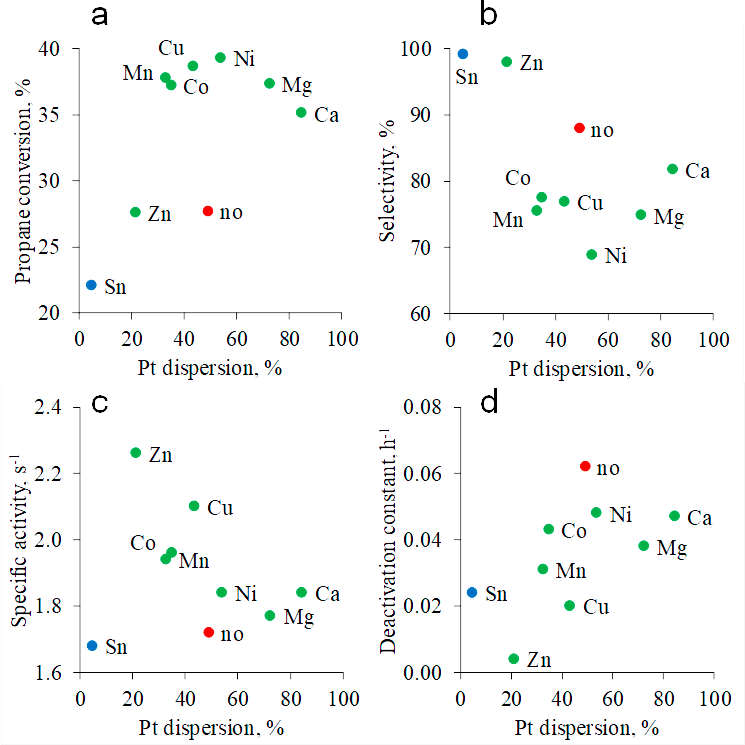
Figure 1. Pt dispersion and catalytic properties for the samples with and without promoter ("no" relates to the sample without the promoter). The reaction conditions: weight hourly space veloсity (WHSV) = 28 h–1, 540 °C, 0.1 MPa. The propane conversion (a), selectivity to propylene (b), and specific activity (c) were measured in1 h of the reaction beginning; the deactivation constants were measured in 8 h on stream.
X-ray diffraction (XRD) analysis revealed that platinum (Pt) particles are too small to be detected, and no reflections indicating the presence of Pt were observed in the XRD patterns of the samples, irrespective of the presence or absence of Mg or Cu (Fig. S1 in the ESI). The same effect was observed for Sn-containing ICW catalysts [8].
The catalytic properties of the samples change with the introduction of promoters. While the activity and stability increase, the selectivity to propylene decreases, except for Sn- and Zn-containing catalysts (Figs. 1a–d, Fig. S2 in the ESI). The reduced activity of the sample with tin can be attributed to a non-optimal Sn/Pt ratio [9] and the co-introduction of metals, when a complex compound of Sn and Pt is formed in the impregnation solution. The reduced C‒C bond breaking ability of Pt in the presence of Sn and Zn renders their popularity as the promoters in Pt-based PDH catalysts [3].
The presence of specific promoters that enhance activity and decrease selectivity suggests that these promoters operate by diluting Pt atoms, showing minimal or no interaction with platinum. In contrast, the enhanced selectivity of Sn- and Zn-promoted catalysts indicates a robust interaction between the promoter and Pt [1–4]. This may be a result of the electronic structure of the promoter atoms.
The effects of the promoters were compared using an index of productivity [10], which is the quotient of dividing the specific activity by a deactivation constant (Fig. 2). Zn, Cu, Sn, and Mn were the best promoters in terms of productivity. Among the tested promoters, Zn and Sn showed the highest propylene selectivity and the lowest Pt dispersion values.
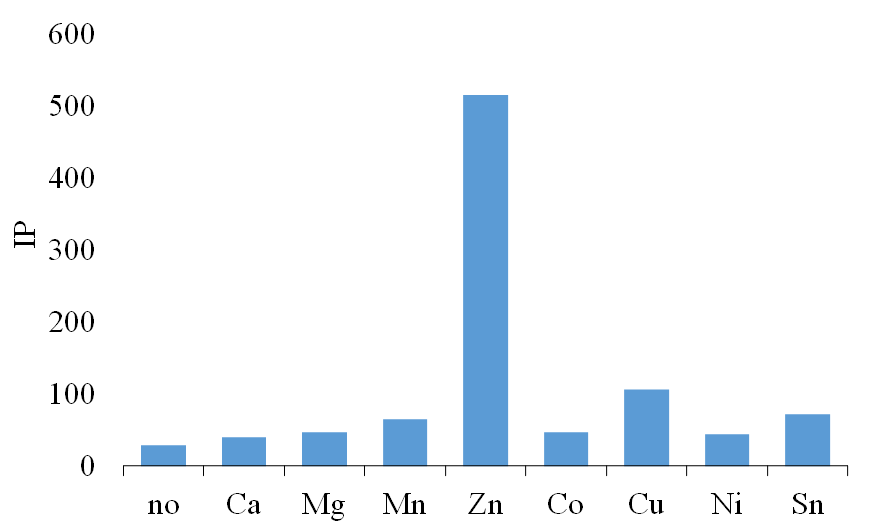
Figure 2. Indices of productivity for the promoted PDH catalysts.
Table S2 in the ESI summarizes the data on some Pt catalysts for propane dehydrogenation reported to date in comparison with the catalysts prepared in the present study. The ICW catalyst (3Na)400w150(0.5Zn0.5Pt) demonstrated high specific activity and stability, comparable with the performance of the best promoted Pt/MFI catalysts described in the literature, while maintaining the propylene selectivity of 98–99%.
Conclusions
Thus, incorporating divalent metals as platinum promoters provides control over the Pt dispersion and enhances the catalytic properties. The high Pt dispersion does not guarantee a highly active and stable promoted PDH catalyst. Zn-, Cu-, Sn-, and Mn-containing ICW MFI zeolite Pt-based catalysts are the most promising catalysts for the PDH reaction.
Acknowledgements
This work was supported by the Ministry of Science and Higher Education of the Russian Federation (agreement no. 075-00276-25-00).
Electronic supplementary information
Electronic supplementary information (ESI) available online: the experimental section. For ESI, see DOI: 10.32931/io2511a.
References
- M. Martino, E. Meloni, G. Festa, V. Palma, Catalysts, 2021, 11, 1070. DOI: 10.3390/catal11091070
- J. J. H. B. Sattler, J. Ruiz-Martinez, E. Santillan-Jimenez, B. M. Weckhuysen, Chem. Rev., 2014, 114, 10613–10653. DOI: 10.1021/cr5002436
- Z.-P. Hu, D. Yang, Z. Wang, Z.-Y. Yuan, Chin. J. Catal., 2019, 40, 1233–1254. DOI: 10.1016/S1872-2067(19)63360-7
- L. Deng, J. Wang, Z. Wu, C. Liu, L. Qing, X. Liu, J. Xu, Z. Zhou, M. Xu, J. Alloys Compd., 2022, 909, 164820. DOI: 10.1016/j.jallcom.2022.164820
- A. B. Ponomaryov, A. V. Smirnov, E. V. Pisarenko, M. V. Shostakovsky, Microporous Mesoporous Mater., 2022, 339, 112010. DOI: 10.1016/j.micromeso.2022.112010
- R. D. Cortright, J. A. Dumesic, J. Catal., 1994, 148, 771–778. DOI: 10.1006/jcat.1994.1263
- R. Geyer, J. Hunold, M. Keck, P. Kraak, A. Pachulski, R. Schödel, Chem. Ing. Tech., 2012, 84, 160–164. DOI: 10.1002/cite.201100101
- A. B. Ponomaryov, A. V. Smirnov, M. V. Shostakovsky, E. V. Pisarenko, A. G. Popov, M. A. Kashkina, Pet. Chem., 2024, 64, 1147–1158. DOI: 10.1134/S096554412404008X
- O. B. Belskaya, L. N. Stepanova, A. I. Nizovskii, A. V. Kalinkin, S. B. Erenburg, S. V. Trubina, K. O. Kvashnina, N. N. Leont'eva, T. I. Gulyaeva, M. V. Trenikhin, V. I. Bukhtiyarov, V. A. Likholobov, Catal. Today, 2019, 329, 187–196. DOI: 10.1016/j.cattod.2018.11.081
- A. B. Ponomaryov, A. V. Smirnov, E. V. Pisarenko, M. V. Shostakovsky, Appl. Catal., A, 2024, 673, 119588. DOI: 10.1016/j.apcata.2024.119588